2026-03-31
Keynote Speech by Academician Daiming Fan of the Chinese Academy of Engineering at the 3rd World Conference on Artificial Consciousness
At the 3rd World Conference on Artificial Consciousness, held in Shenzhen on March 21, 2026, the World Academy of Artificial Consciousness presented certificates to Professor James J. Heckman, recipient of the 2000 Nobel Prize in Economic Sciences, and Professor Seeram Ramakrishna, Foreign Member of the Chinese Academy of Engineering. The conference was themed "Fundamental Theories and Practical Exploration of Artificial Consciousness, and Artificial Intelligence Empowering Proactive Health Medicine."
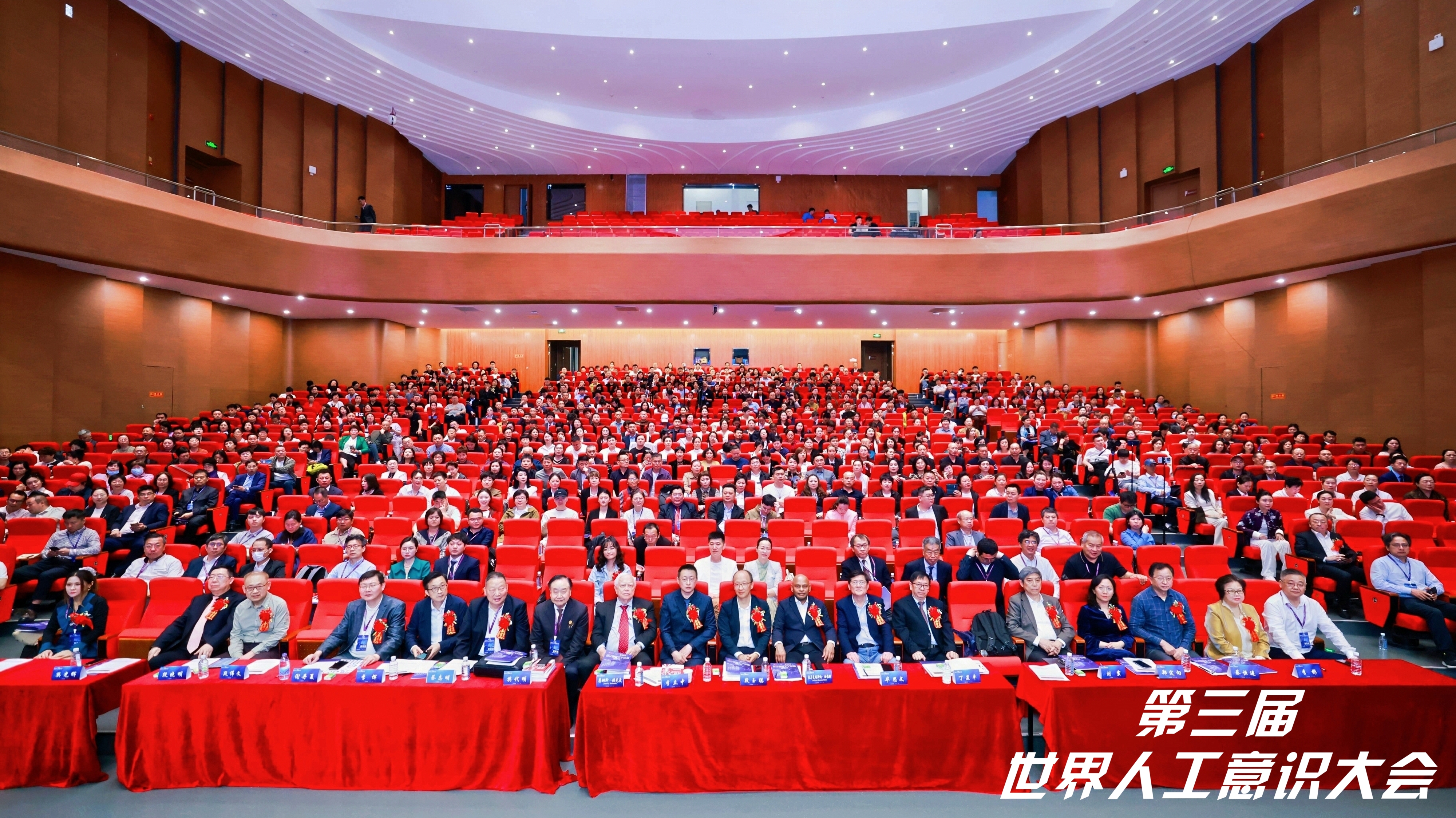
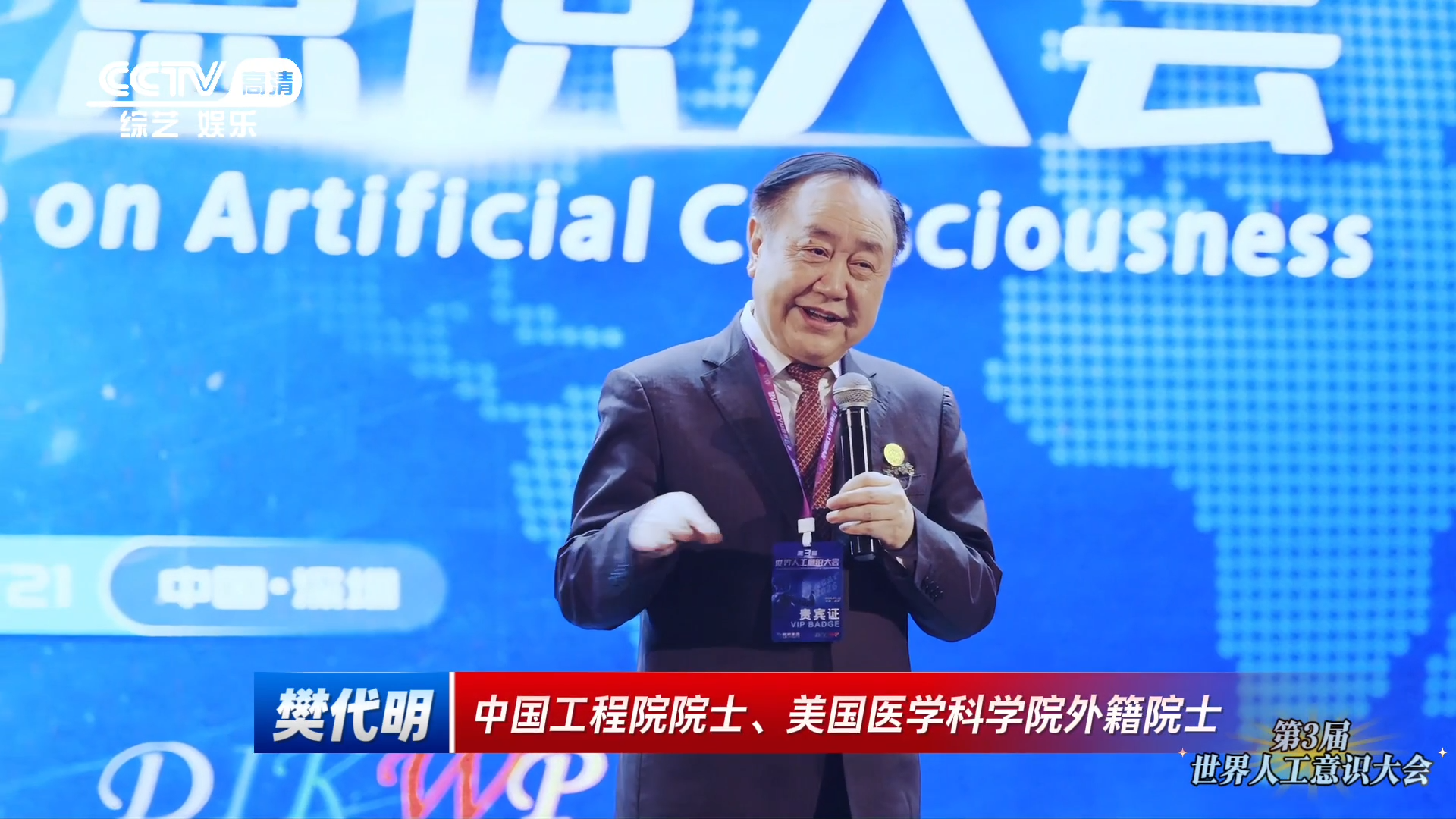
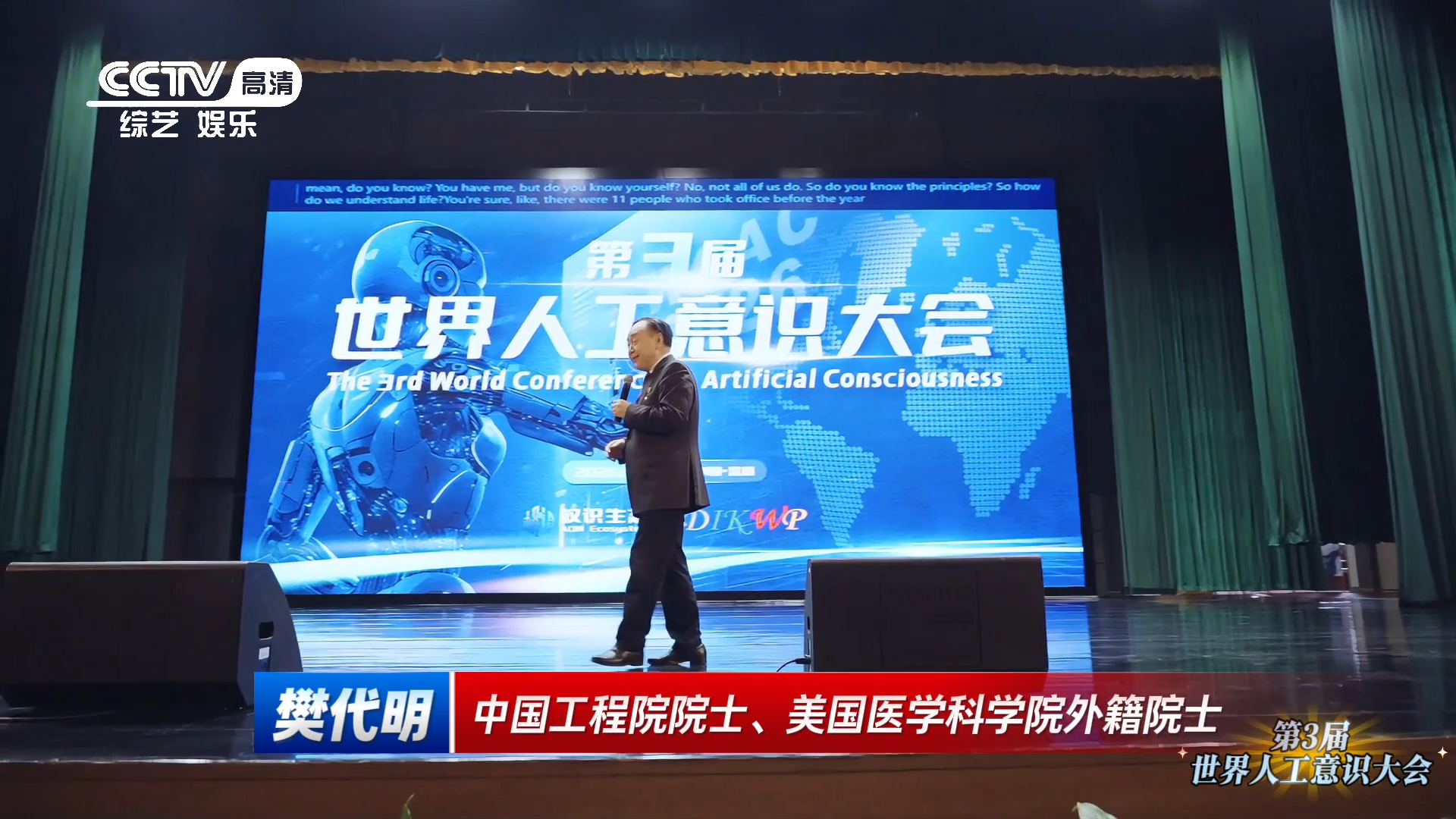
The following is the keynote speech manuscript delivered by Chinese Academy of Engineering academician Daiming Fan for the 3rd World Conference on Artificial Consciousness. In this address, Fan reflects on consciousness through medicine, integrative thinking, and a life-centered understanding of intelligence and emergence.
Distinguished moderator, esteemed experts, and dear friends, thank you very much for the invitation. Today I would like to share a few reflections on life, consciousness, and intelligence, drawing on medicine, the history of science, and holistic ideas that are deeply rooted in Chinese thought.
In my view, consciousness is not an isolated abstraction. It is a state and capacity that emerges when life develops to a higher level of organization and expression. We often describe cognition as a progression from numbers to data, from data to information, from information to knowledge, and from knowledge to wisdom. Yet wisdom is still incomplete if it does not enter action and become an effective expression of life. For that reason, any serious discussion of consciousness must remain grounded in life itself.
As a physician, I am constantly reminded of the importance of life. Medicine is, in essence, concerned with saving lives. But saving life is not only about maintaining temperature, pulse, respiration, and heartbeat. It is also about preserving awareness, mental presence, and the integrity of the living person. Without consciousness and mental vitality, life loses its full meaning.
Therefore, when we discuss artificial consciousness or advanced intelligence, the first question should not be only about algorithms or computing power. We must ask a more fundamental question: What is life, and on what basis does consciousness arise? Only by beginning with life itself can we understand the origin, level, and limits of consciousness in a more rigorous way.
Pythagoras famously proposed that all things are number. This insight profoundly shaped scientific thought. Since life belongs to the world of things, one may naturally argue that life can also be expressed numerically. There is truth in that idea, but only partial truth. Numbers matter, quantification matters, and computation matters; but life cannot be exhausted by number alone.
This is precisely why the question raised by Schrödinger in What Is Life? remains important. Mathematics, physics, and chemistry are indispensable tools for understanding life, yet they do not amount to life itself. Even if binary systems can encode vast amounts of information, they still cannot fully capture the complexity, wholeness, and generative character of living systems.
If I were to summarize the essence of life in a more appropriate language, I would emphasize two key terms. The first is diversity. Life is not determined by a single factor, a single element, or a single structure. Rather, it unfolds as a richly layered and internally coordinated whole composed of many interacting parts.
The second is dynamism. Life is not closed and static. It is open, changing, and continuously interacting with its environment. Life is life precisely because it is always in motion, always adjusting, always exchanging, and always reorganizing itself.
When diversity and dynamism are combined, life can no longer be treated as a simple object that can be reduced without remainder. It must instead be understood as a highly complex system.
Having many elements does not automatically produce life. What matters is the pattern of relations among them. Life is not a mere pile of numbers, molecules, organs, or signals. It is the result of a relational network in which structures, levels, and systems continually influence one another.
From a medical perspective, the quality and state of life are often determined not by any isolated variable but by coupling, coordination, and interaction across the whole organism. In other words, the decisive question is not simply what is present, but how things are connected.
Yet relations alone are still not enough. Life also requires emergence. By emergence, I mean the production of a higher-level function from the interaction of lower-level functions, where the new function is not already contained in the components taken separately. It is not simple addition; it is the generation of a new quality.
Because of repeated emergence, life rises from lower-level material movement to higher levels of organization, function, expression, and finally consciousness. Consciousness does not arrive from nowhere. It appears through accumulated organization and successive elevation within living systems.
Life also has a characteristic mode of development that may be described as spiral ascent. Matter does not exist in stillness; it exists in motion, in time, and in interaction with its environment. Life is especially so. Its development is neither purely linear nor merely repetitive. It advances through dynamic recurrence and elevation.
Seen from one angle, this may look like wave-like movement; seen more fully, it resembles a spiral. Each return is not a simple return to the same point, because time has entered the process. Each cycle unfolds under new conditions and at a new level. This sustained movement, energy absorption, organization, and reorganization is part of the true form of life.
For this reason, life and consciousness cannot be understood through a single linear mode of reasoning. Logical thinking is important, but it is often best suited only for local, momentary, or highly simplified problems. Once we enter long-term processes, complex relations, and multilayered interactions, any single mode of thought becomes insufficient.
We therefore need holistic thinking, dynamic thinking, imagistic thinking, dialectical thinking, strategic and game-oriented thinking, relational thinking, multidimensional thinking, and even reverse thinking. Only when our own thinking becomes more integrated and open can we begin to approach the full picture of life and gain a deeper understanding of consciousness.
My own work in medicine has led me to advocate integrative medicine. At its core, integrative medicine reconnects fragmented knowledge, technologies, disciplines, and experiences so that life, disease, and health can be understood more completely. It resists mechanical fragmentation and the tendency to see only parts while losing sight of the whole.
This has clear implications for artificial intelligence and artificial consciousness. If we define consciousness as nothing more than a computational output, or if we define life as something fully replaceable by a set of static indicators, our understanding will remain too narrow. A more promising path is to rethink life, intelligence, and consciousness through the framework of wholeness, relationality, dynamism, and emergence.
In conclusion, consciousness arises from life. Life is not merely a collection of numbers, not a static assembly of structures, and not a mechanical sum of local variables. Its essence lies in diversity, dynamism, relationality, and emergence. Consciousness is a higher expression gradually formed and elevated within such living movement.
If we study life and intelligence from a more holistic, open, and dynamic perspective, then medicine, integrative medicine, and artificial consciousness research may all move into a new stage of development. Thank you very much.