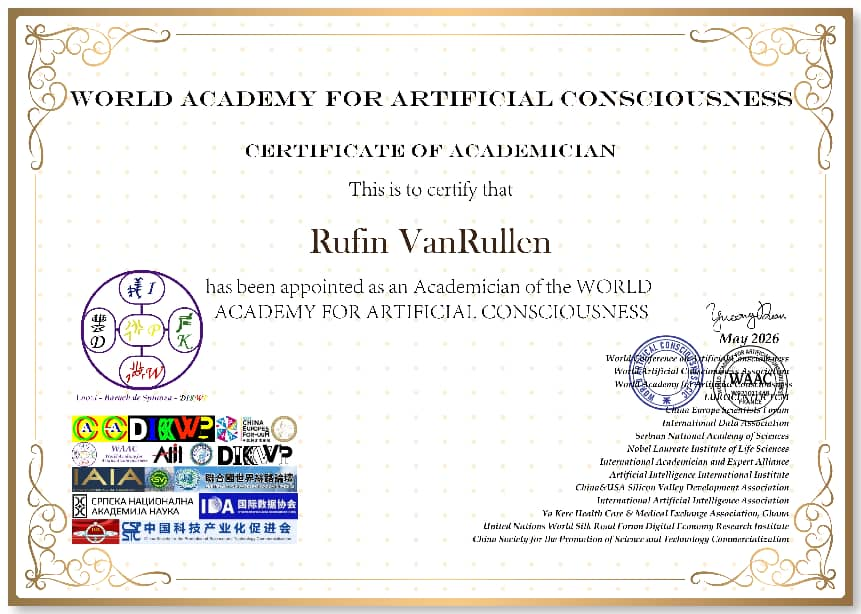
We are pleased to announce that Rufin VanRullen, CNRS Research Director at the Centre de Recherche Cerveau & Cognition (CerCo) in Toulouse and AI Research Chair at the Artificial and Natural Intelligence Toulouse Institute (ANITI), has been elected as an Academician of the World Academy of Artificial Consciousness (WAAC), in recognition of his sustained academic contributions to cognitive neuroscience, visual perception, neural oscillations, deep learning, brain-inspired artificial intelligence, Global Workspace Theory, and computational models of artificial consciousness. His institutional affiliations and GLoW project are confirmed by CerCo and ANITI-related sources.
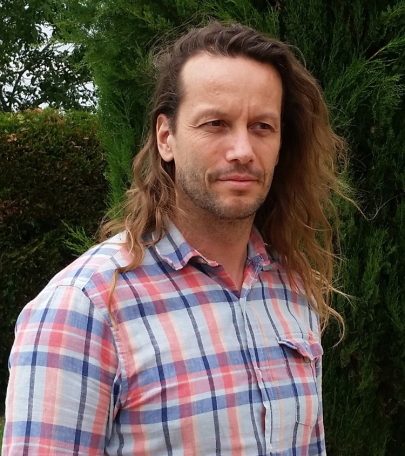
Professor VanRullen has long been dedicated to interdisciplinary research at the intersection of artificial intelligence and neuroscience. His work focuses on human visual perception, attention, neural coding, perceptual cycles, feed-forward and feedback processing, neural oscillations, and brain-inspired computational models. Starting from cognitive neuroscience, his research investigates how the human brain organizes information flow across multiple perceptual and cognitive modules, and further translates these mechanisms into implementable and testable artificial intelligence models. This work provides important theoretical foundations and technical pathways for understanding natural intelligence and constructing next-generation artificial intelligence systems.
In the fields of consciousness theory and foundational research on artificial consciousness, Professor VanRullen has continuously advanced the integration of Global Workspace Theory (GWT) with deep learning models. In his work with collaborators, he proposed the idea of a Global Latent Workspace, which uses unsupervised neural translation between multiple latent spaces to construct a unified, cross-modal global latent workspace. This mechanism supports information integration and broadcasting among different perceptual, linguistic, action-oriented, and cognitive modules. This research direction not only offers a new technical route for the computational implementation of Global Workspace Theory, but also provides important reference value for multimodal integration, flexible cognition, information broadcasting, attentional selection, and explainable cognitive architecture in artificial consciousness systems.
WAAC believes that the development of artificial consciousness requires not only large-scale artificial intelligence models and engineering implementation, but also systematic support from cognitive neuroscience, consciousness theory, neural computation, brain-inspired architectures, and formal cognitive modeling. Professor VanRullen’s research connects visual neuroscience, cognitive modeling, deep learning, Global Workspace Theory, and artificial intelligence architecture design. In particular, his work has made representative contributions to transforming consciousness theories into computable, implementable, and testable artificial intelligence models. His research provides important scientific foundations and methodological inspiration for how artificial consciousness systems may achieve cross-modal information integration, global broadcasting, flexible reasoning, attentional selection, and cognitive control.
In recognition of his outstanding contributions to cognitive neuroscience, brain-inspired artificial intelligence, Global Workspace Theory, Global Latent Workspace, deep-learning cognitive architectures, and the foundational theory of artificial consciousness, the World Academy of Artificial Consciousness has decided to confer upon Professor Rufin VanRullen the title of WAAC Academician. WAAC looks forward to further promoting cross-disciplinary exchange among artificial consciousness, consciousness science, cognitive neuroscience, theoretical neuroscience, brain-inspired artificial intelligence, and multimodal intelligent systems, and to jointly exploring new pathways through which advanced intelligent systems can serve human cognitive understanding, scientific discovery, and the future development of civilization.
- Global Collaboration and Academic Ecosystem
Academicians of the World Academy of Artificial Consciousness hail from institutions such as Harvard University, the Massachusetts Institute of Technology, the University of Cambridge, the University of California, the French Academy of Sciences, the University of Padua, the University of Oxford, the University of Queensland, Columbia University, and the University of Exeter. Honorary Academicians come from a wide range of countries and regions, including the United States, the United Kingdom, France, Germany, Italy, Sweden, Canada, Australia, Spain, and China. In addition, leading scientists from prominent research institutes and technology companies—such as Google, the Allen Institute for Brain Science, and ZEEKR—also participate.
- About WAAC
The World Academy of Artificial Consciousness (https://www.waac.ac/) is a global academic institution established in Paris in 2025. Its mission is to advance frontier research and international collaboration in artificial consciousness through the integration of science, technology, and philosophy. The Academy publishes open research, policy recommendations, evaluation standards, and more. The current President is Academician Yucong Duan, and the Secretary-General is Dr. Yingbo Li. The Honorary Academician List: On May 3, 2025, WAAC released its first batch of Top 100 Honorary Academicians, recognizing scholars who have made foundational or leading contributions to the theory of artificial consciousness.