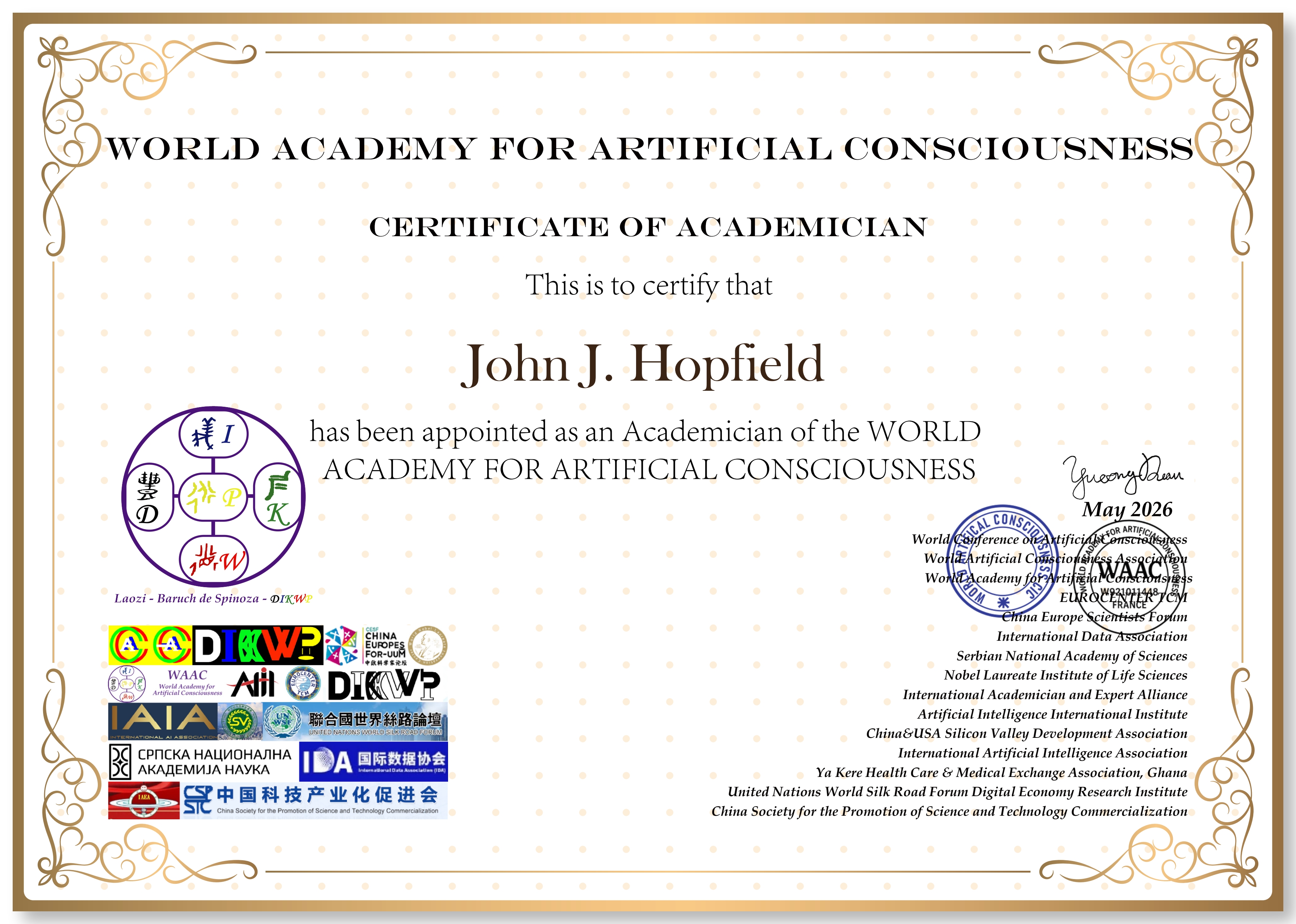
We are pleased to announce that Professor John J. Hopfield, Nobel Laureate in Physics 2024 and Professor Emeritus at Princeton University, has been elected as an Academician of the World Academy of Artificial Consciousness (WAAC) in recognition of his foundational contributions to artificial neural networks, associative memory, complex systems, computational neuroscience, physics-inspired machine learning, and the fundamental theories of intelligent systems.
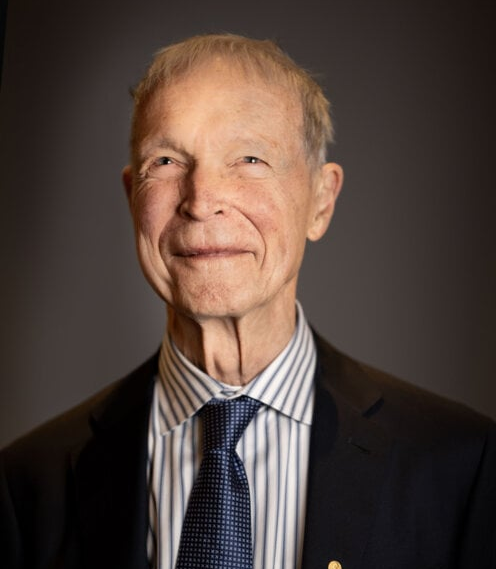
Professor John J. Hopfield is the Howard A. Prior Professor in the Life Sciences, Emeritus, and Professor of Molecular Biology, Emeritus, at Princeton University. His academic work has long maintained close connections across physics, neuroscience, molecular biology, and computational theory. In 2024, Professor Hopfield shared the Nobel Prize in Physics with Professor Geoffrey E. Hinton. The prize was awarded “for foundational discoveries and inventions that enable machine learning with artificial neural networks.” Among Professor Hopfield’s most representative contributions is the Hopfield network, an associative-memory neural network model capable of storing, reconstructing, and recovering patterns. This model introduced concepts such as energy functions, attractor dynamics, many-body systems, and collective behavior from physics into neural network research, providing a profound theoretical foundation for understanding memory, representation, pattern recovery, and intelligent computation.
WAAC believes that the development of artificial consciousness requires not only large-scale artificial intelligence models, deep learning engineering systems, and cognitive architectures, but also foundational support from physics, neuroscience, complex systems, computational modeling, and theories of intelligence. Professor Hopfield’s research has revealed, from a physics-based perspective, how neural networks form stable states through collective dynamics, how they recover patterns from incomplete or corrupted information, and how memory, recognition, and representational organization can emerge in complex systems. These ideas offer important inspiration for artificial consciousness research: artificial consciousness systems require not only perception and generation capabilities, but also interpretable memory structures, stable internal states, self-organizing semantic representations, goal-oriented state-evolution mechanisms, and computable modeling of their own information-processing processes.
In recognition of his outstanding contributions to artificial neural networks, associative memory, complex system dynamics, computational neuroscience, physics-inspired machine learning, and the fundamental theories of intelligent systems, the World Academy of Artificial Consciousness has decided to confer upon Professor John J. Hopfield the title of WAAC Academician. Professor Hopfield’s academic work spans physics, life sciences, neuroscience, and artificial intelligence. It has laid an important foundation for the development of modern machine learning and provides significant theoretical resources for exploring memory, representation, self-organization, stable states, and explainable mechanisms of intelligent systems in artificial consciousness research.
- Global Collaboration and Academic Ecosystem
Academicians of the World Academy for Artificial Consciousness hail from institutions such as Harvard University, the Massachusetts Institute of Technology, the University of Cambridge, the University of California, the French Academy of Sciences, the University of Padua, the University of Oxford, the University of Queensland, Columbia University, and the University of Exeter. Honorary Academicians come from a wide range of countries and regions, including the United States, the United Kingdom, France, Germany, Italy, Sweden, Canada, Australia, Spain, and China. In addition, leading scientists from prominent research institutes and technology companies—such as Google, the Allen Institute for Brain Science, and ZEEKR—also participate.
- About WAAC
The World Academy for Artificial Consciousness (https://www.waac.ac/) is a global academic institution established in Paris in 2025. Its mission is to advance frontier research and international collaboration in artificial consciousness through the integration of science, technology, and philosophy. The Academy publishes open research, policy recommendations, evaluation standards, and more. The current President is Academician Yucong Duan, and the Secretary-General is Dr. Yingbo Li. The Honorary Academician List: On May 3, 2025, WAAC released its first batch of Top 100 Honorary Academicians, recognizing scholars who have made foundational or leading contributions to the theory of artificial consciousness.