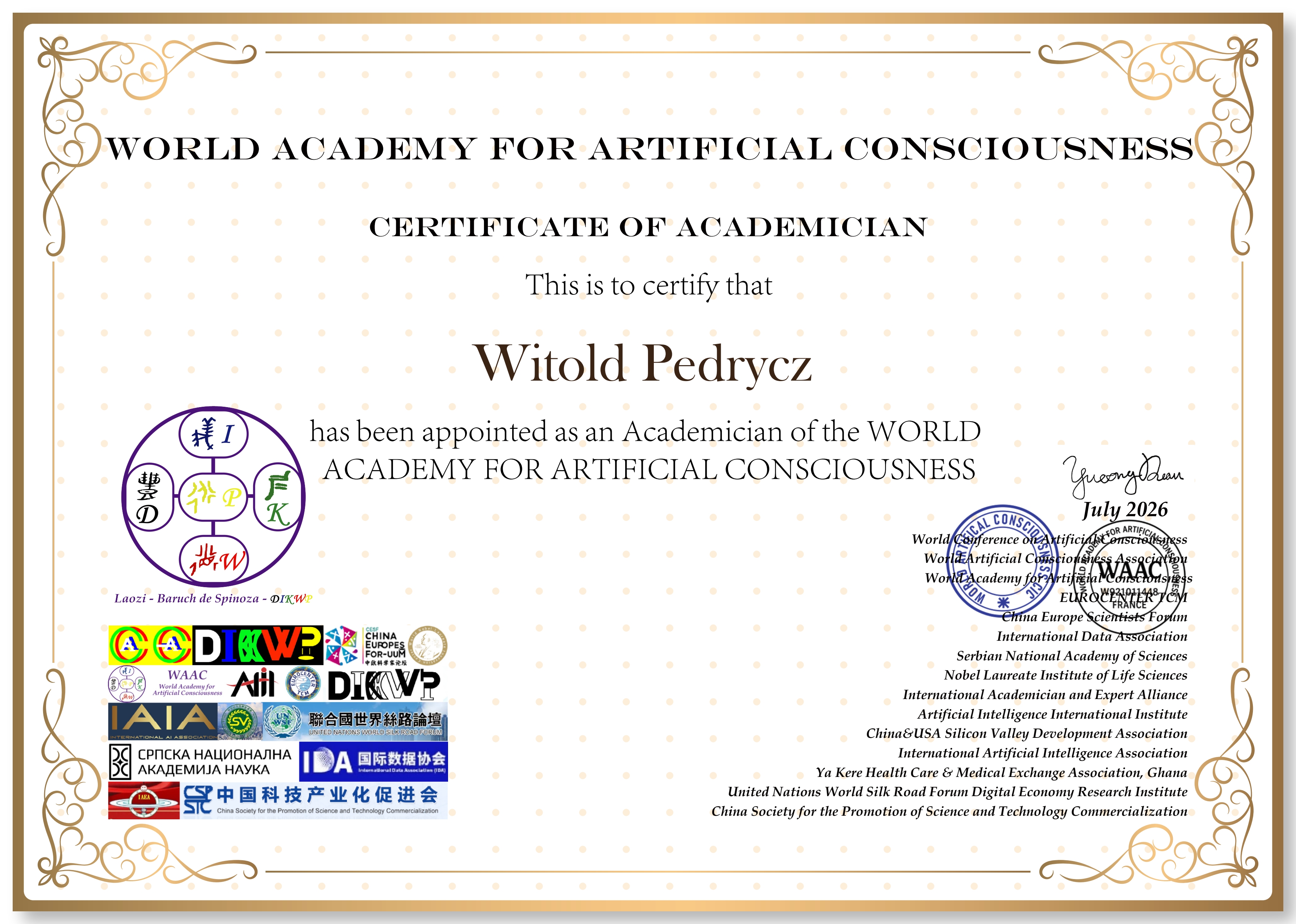
We are pleased to announce that Professor Witold Pedrycz, Professor in the Department of Electrical and Computer Engineering at the University of Alberta, Canada Research Chair in Computational Intelligence, and scholar at the Systems Research Institute of the Polish Academy of Sciences, has been elected as an Academician of the World Academy of Artificial Consciousness (WAAC), in recognition of his important contributions to computational intelligence, granular computing, fuzzy systems, information granules, neuro-fuzzy systems, data-driven modeling, knowledge discovery, pattern recognition, human-centric intelligent systems, and intelligent decision support.
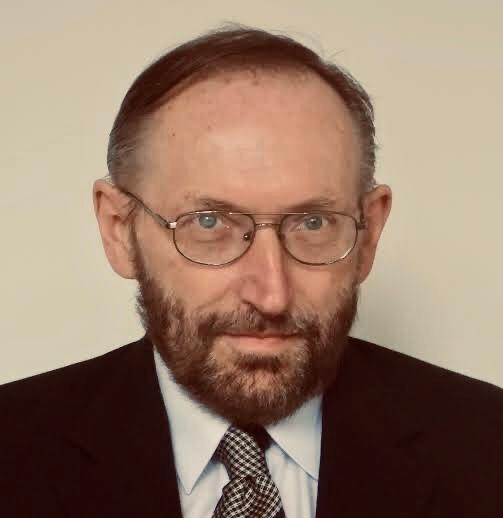
Professor Witold Pedrycz is an internationally influential scholar in contemporary computational intelligence, granular computing, and fuzzy systems research. He has long been dedicated to studying the representation, abstraction, organization, modeling, and reasoning mechanisms of complex information in uncertain, incomplete, and dynamic environments, and has systematically advanced the development of fuzzy sets, neural networks, evolutionary computation, neuro-fuzzy systems, information granules, granular computing, knowledge discovery, and data mining. His research has not only deepened our understanding of information granulation, semantic abstraction, multilevel modeling, uncertainty processing, and the design of human-centric intelligent systems, but has also provided important theoretical and methodological foundations for complex data analysis, interpretable modeling, pattern recognition, intelligent control, collaborative modeling, and knowledge representation. Professor Pedrycz is an IEEE Fellow, Fellow of the Royal Society of Canada, and Foreign Member of the Polish Academy of Sciences. He has received major honors including the IEEE Systems, Man, and Cybernetics Society Norbert Wiener Award, the IEEE Canada Computer Engineering Medal, the Killam Prize, and the IEEE Computational Intelligence Society Fuzzy Pioneer Award, making outstanding contributions to global research in computational intelligence, soft computing, granular computing, and intelligent systems.
WAAC believes that the study of artificial consciousness requires not only advances in artificial intelligence, cognitive science, computational models, and philosophical theory, but also in-depth research into the mechanisms by which complex information is perceived, granulated, abstracted, organized, understood, reasoned about, and used for decision-making. Professor Pedrycz’s work in computational intelligence, granular computing, fuzzy systems, information granules, neuro-fuzzy systems, and human-centric intelligent systems provides important theoretical resources and methodological support for uncertainty cognition, semantic representation, interpretable reasoning, multigranular understanding, knowledge organization, intelligent decision-making, cognitive modeling, and the structured understanding capabilities of future artificial agents. His research path, spanning computational intelligence, information science, knowledge engineering, soft computing, and human-centric intelligent systems, offers significant inspiration for connecting artificial consciousness theory, explainable AI, and the design of complex intelligent systems.
In recognition of his outstanding contributions to computational intelligence, granular computing, fuzzy systems, information granules, neuro-fuzzy systems, knowledge discovery, human-centric intelligent systems, and intelligent decision support, the World Academy of Artificial Consciousness has decided to confer upon Professor Witold Pedrycz the title of WAAC Academician.
- Global Collaboration and Academic Ecosystem
WAAC Academicians come from world-leading universities, national academy systems, and frontier research institutions, including Harvard University, the Massachusetts Institute of Technology, the University of Cambridge, the University of Oxford, the University of California, Columbia University, Princeton University, the University of Chicago, University College London, the University of Padua, the University of Queensland, the University of Exeter, the French Academy of Sciences, the German National Academy of Sciences, the U.S. National Academy of Sciences, the U.S. National Academy of Engineering, the Chinese Academy of Engineering, the Royal Society, the Allen Institute for Brain Science, and the Max Planck Institute. The body of Academicians includes multiple Nobel Prize laureates, Turing Award laureates, members of national academies of sciences and engineering, Fellows of the Royal Society, and Fellows of internationally important academic organizations such as IEEE, AAAI, AAAS, and the British Academy. By bringing together leading scholars in natural consciousness research, machine consciousness modeling, brain science mechanisms, cognitive robotics, deep learning, brain-computer interfaces, and AI governance, WAAC has built an artificial consciousness research ecosystem that combines scientific depth, technological frontier orientation, philosophical insight, and global collaborative capacity, demonstrating its academic foundation and international influence in the emerging field of artificial consciousness science.
- About WAAC
The World Academy for Artificial Consciousness (https://www.waac.ac/) is a global academic institution established in Paris in 2025. Its mission is to advance frontier research and international collaboration in artificial consciousness through the integration of science, technology, and philosophy. The Academy publishes open research, policy recommendations, evaluation standards, and more. The current President is Academician Yucong Duan, and the Secretary-General is Dr. Yingbo Li. The Honorary Academician List: On May 3, 2025, WAAC released its first batch of Top 100 Honorary Academicians, recognizing scholars who have made foundational or leading contributions to the theory of artificial consciousness.